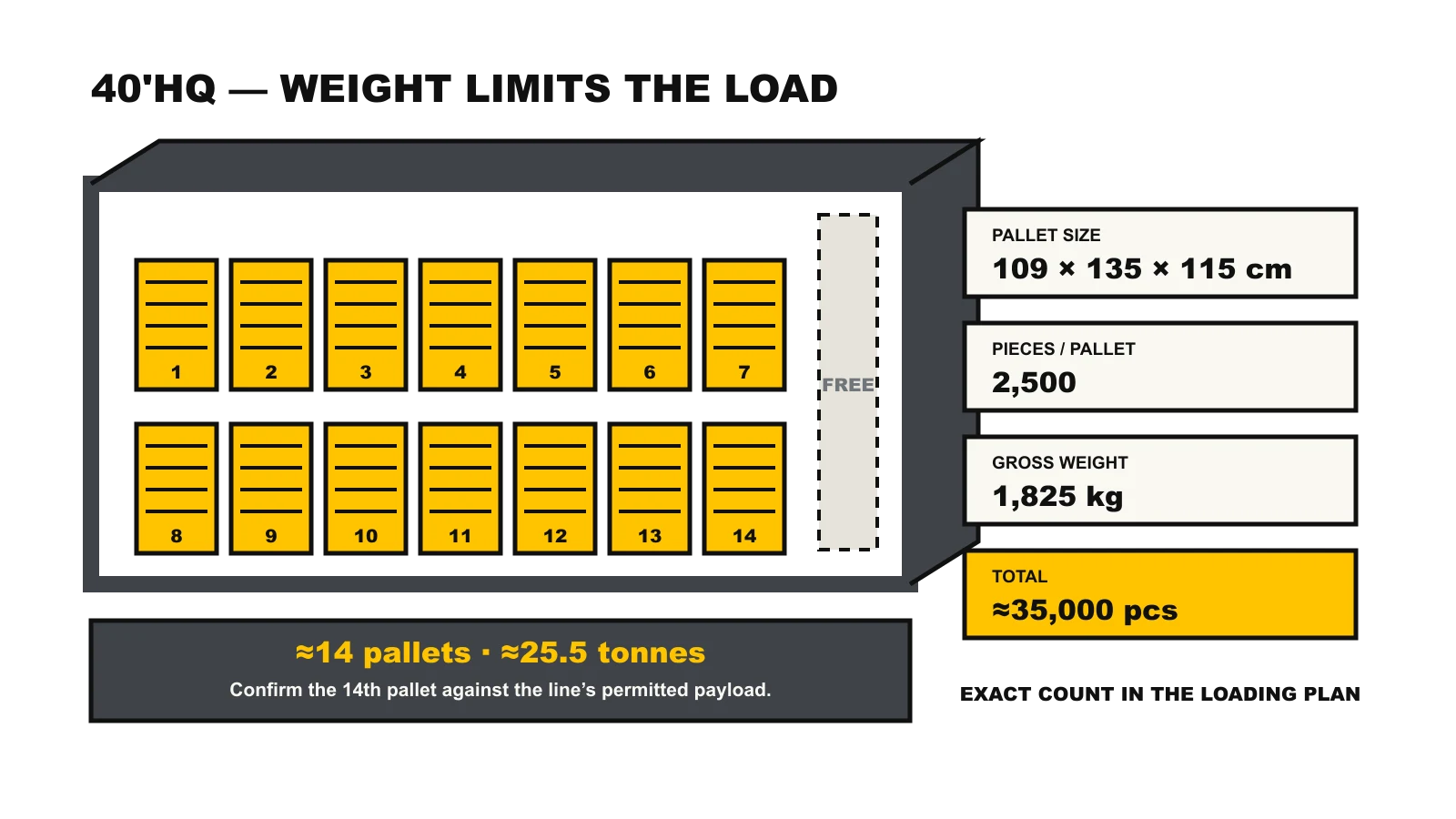
How many roadside delineators fit in a 40'HQ?

Short answer: weight runs out before volume does. Below is the calculation from our own pallet data, step by step. And why the container hits its weight limit before it fills.

Pallet data

Size (h × w × l)
109 × 135 × 115 cm
Pieces per pallet
2,500
Pallet weight
1,825 kg
40'HQ loading: 13 pallets, about 32,500 pieces — the limit is weight, not volume
The exact pallet count is in the loading plan; the net load the carrier allows decides it.

The calculation

  1. 1Pallet footprint135 × 115 cmA floor area of 1.55 m². Height 109 cm — whether the 40’HQ interior height allows double stacking depends on packaging strength.
  2. 2Pieces per pallet2,500 pcsPosts are stacked side by side rather than nested; this figure comes from the manufacturer’s own packing plan.
  3. 3Pallet weight1,825 kgGross weight including the timber pallet.
  4. 4Pallets from the weight limit13 pallets25,500 kg ÷ 1,825 kg ≈ 13.9 — round DOWN: 14 pallets would weigh 25,550 kg and break the limit. 25,500 kg is our working standard; if your line states a different payload, the plan is updated to it.
  5. 5Total pieces≈ 32,500 pcs13 pallets × 2,500 pcs. An approximation; the exact number comes with the loading plan.

Weight is the limit

The net payload of a 40'HQ is typically in the 26–28 tonne band. The exact figure depends on the container’s tare weight and the road weight limit in the destination country.

At 1,825 kg per pallet, a 25,500 kg working limit is reached at 13 pallets; a 14th would exceed it. So the weight limit fills before the volume does, even when floor space remains.

Limits of this figure

The pallet data here is for our standard 1300 mm post. A different length, different packing or a mixed load changes the count. This page is an estimating aid; the binding figure comes with the quotation.

For an exact figure

Send us the destination country and port. We work out the exact loading plan from the line’s container tare and that country’s road weight limit, and attach it to the quote.

Request a Quote

Common mistakes, and what to ask for

The commonest mistake in container maths is looking only at volume. On some products it is weight rather than volume that fills the container. Rubber humps, wheel stops and filled barriers belong to that group.

A count given on volume alone splits the shipment in two when it meets the weight limit, and the freight exceeds what was expected.

The second mistake is leaving the pallet plan until after the order. Pallet size is built around the product height, and the arrangement inside the container follows from it.

Without a pallet plan discussed before the order, the same count can need a container and a half instead of one.

A mixed load is often the cheapest answer. Filling the gaps of one product with another gives a higher fill than a single-item load.

When asking for a quotation, therefore, share the list of the whole order rather than one product.

The calculation is needed for the installation plan as well as the freight. The container count decides how many deliveries reach the site and which week the crew works.

The loading plan is the first line of the programme.

The loading plan counts as part of the order documents. The pallet size, the count per pallet, the gross weight and the container number are shared in writing.

A difference during shipment then becomes a correction rather than a dispute.

Empty volume is a cost as well. If a tenth of the container travels empty, freight is paid for that space too.

The loading plan is therefore not finished before the order list is fixed, and the last items are chosen to fill it.

The loading calculation is shared with the installation crew. When it is written which pallet carries which product, the crew finds what it needs while unloading rather than searching for it.

That saves half of the first day.

The calculation is fixed in the quotation and redone if the order changes. A single item added later can break the pallet plan, so the loading plan is confirmed once more after the order list closes.

The freight quotation and the loading plan meet in one document.

The carrier prices by the container, and without the link between product count and container count the unit cost cannot be calculated and quotations cannot be compared.

The last step of the calculation is insurance. The value declared per container must agree with the pallet plan and the product count.

A mismatched declaration delays payment after damage and usually ends in a partial settlement.

A loading photograph is part of the documentation as well. A frame taken before the doors close shows the pallet arrangement and the stacking height.

When damage appears on arrival it alone separates damage in transit from damage at loading.

Get a quote

Quantity, destination country and your specification if you have one. A technical answer on your enquiry comes back the same day; pricing is prepared by a person, never auto-generated.

Request a Quote