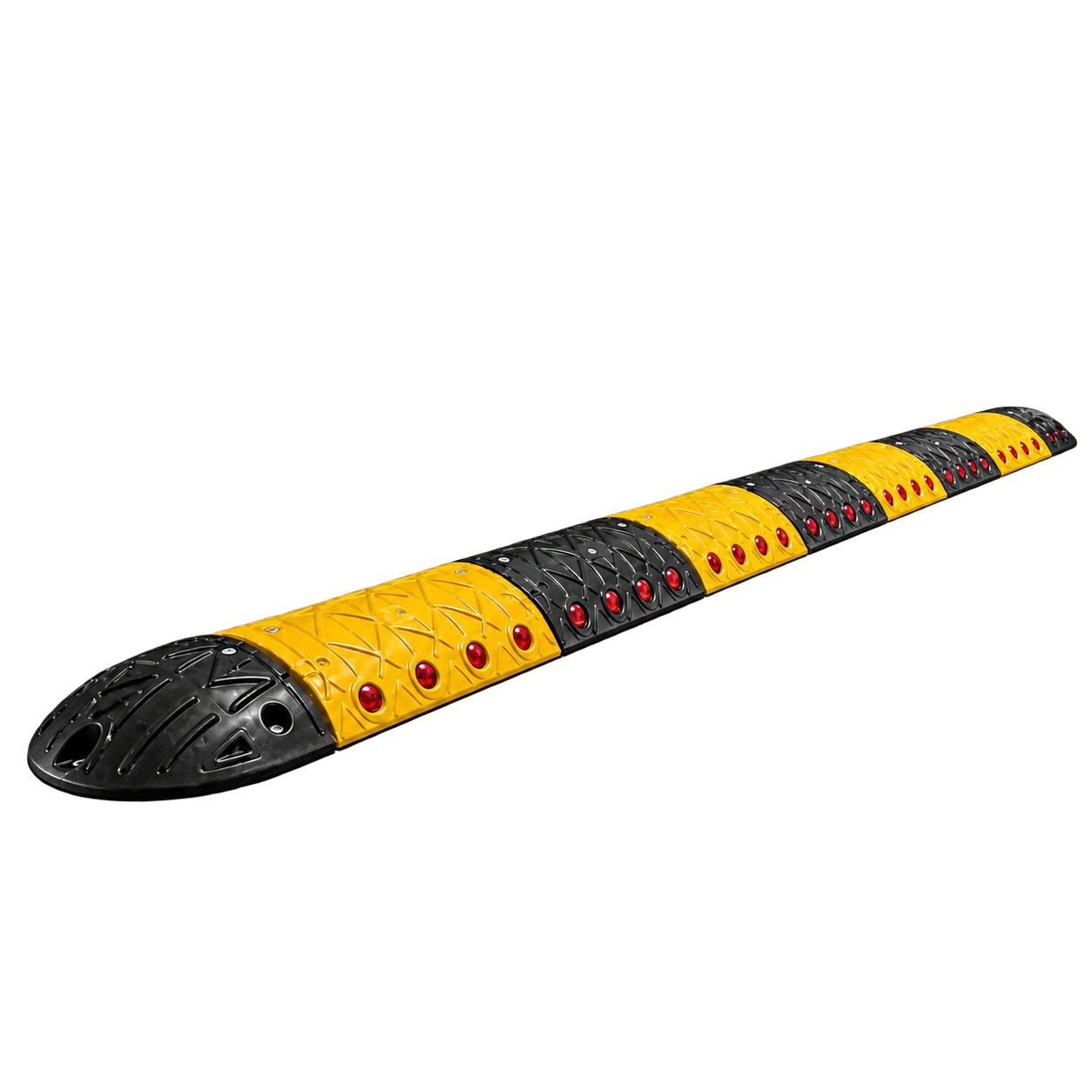
What height should a speed bump be?

Short answer

Height is the counterpart of the target speed: as the target drops, the profile rises. Beyond a point, though, height starts producing discomfort and damage.

The geometry of a speed bump — height, width and ramp angle. Is set by the national road regulations rather than by a product standard. In export, then, the right question is not “which standard” but “which country’s regulation”.

The practical rule is that what slows a vehicle is the steepness of the ramp more than the height. At the same height, a long ramp produces a comfortable deceleration while a short one produces a jolt and suspension damage. Complaints usually come from the ramp, not the height.

On ambulance, fire and bus routes a cushion type replaces the full-width bump. A narrow vehicle slows while a wide-axle vehicle passes between. This is the standard way of protecting emergency response times.

Height alone does not deliver the target speed; it works with width. A narrow, tall profile jolts the vehicle and cuts speed sharply. A wide, low profile lifts the vehicle and limits speed gently.

On routes used by ambulances and fire appliances the profile is judged separately. A harsh hump does not merely slow the emergency vehicle; it damages its equipment and its patient. Wide profiles or cushion arrangements are preferred there.

Spacing is part of the calculation. A single hump slows the vehicle at one point and the driver accelerates again. Where the limit must hold along the route, humps repeat at regular intervals.

What belongs in the specification is the target speed rather than the height. Given a target speed the profile, width and spacing are chosen together. A specification giving only a height can be met by very different products.

The specification carries the target speed, the road width and the vehicle types using it. Given those three, the profile, length and spacing can be calculated. A specification giving only a height describes a product rather than a measure.

The commonest mistake is placing a single hump at one point. The driver accelerates after it and the measured average speed does not change. An effective layout repeats along the route and gives the driver a consistent rhythm.

The question for a supplier is what acceleration the profile produces at what speed. A supplier who cannot give that has not measured the product, and an unmeasured hump cannot promise a target speed.

The installation plan also accounts for drainage. A hump laid across the road interrupts the water. On a gradient it ponds in front of the hump and freezes in winter. The layout is therefore planned together with the drainage line.

This page does not replace a road geometry calculation. Gradient, curvature and sight distance change where a hump belongs. On critical routes the decision belongs to a road engineer rather than to a catalogue.

The visibility of the hump is part of the calculation too. A hump not seen at night produces suspension damage rather than lower speed, so the reflective strip and the approach sign are planned with the product.

People asking this also looked at

Get a quote for this product

Quantity, destination country and your specification if you have one. A technical answer on What height should a speed bump be? comes back the same day; pricing is prepared by a person, never auto-generated.

Request a Quote