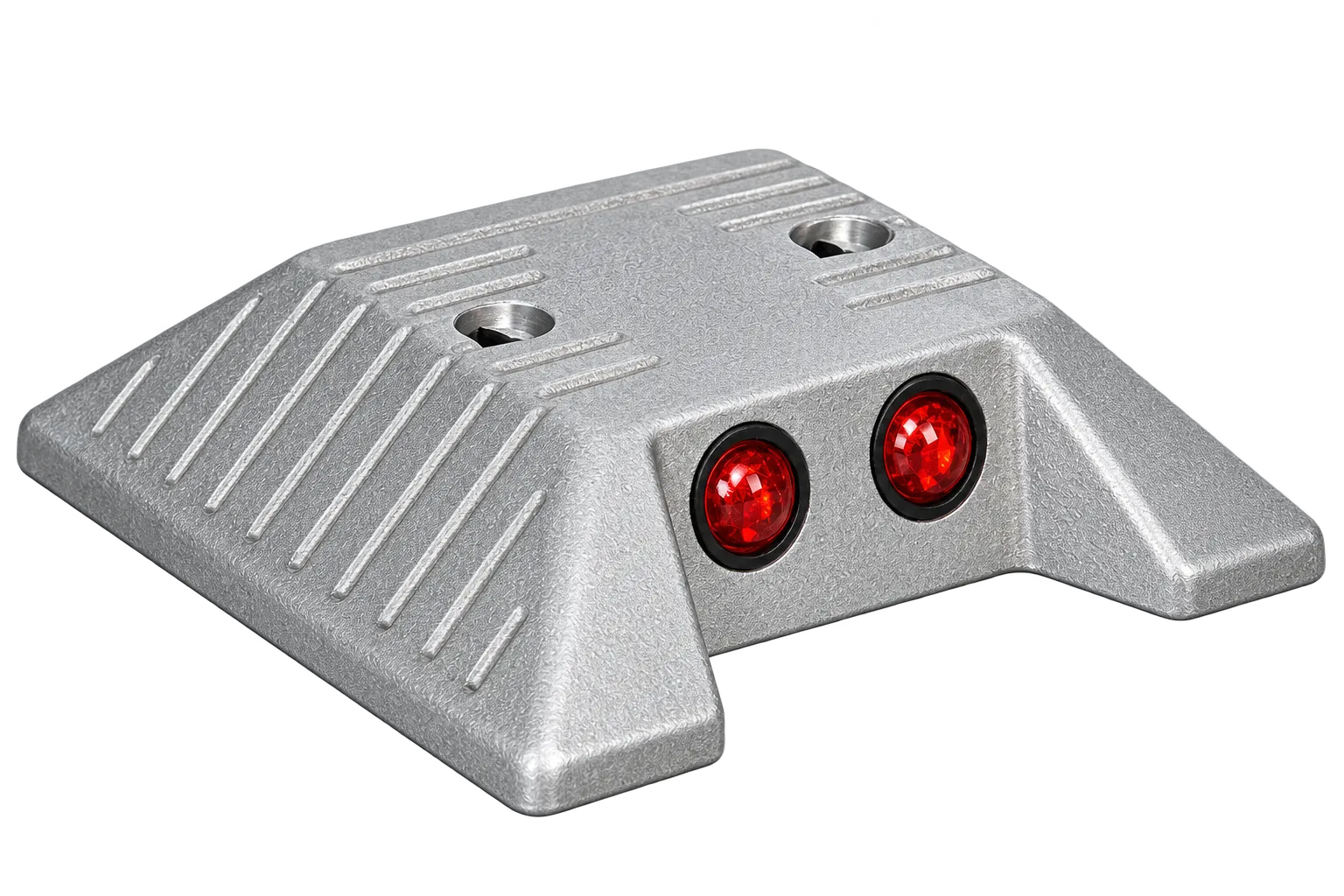
Road studs: solar or retroreflective?
Short answer
A retroreflective stud returns the headlight beam: cheap and maintenance-free. A solar stud makes its own light and earns its place where the beam does not reach — on bends and at junctions.
A retroreflective stud only works when a headlight falls on it. That is enough on a straight, but on a bend the beam points off the road rather than along it. The stud dark exactly where it is needed. This is the problem the solar stud solves.
Against that, a solar stud has a battery that ends its life and a body that costs more. A mixed layout is possible — retroreflective along the route, solar on bends and junction approaches — provided the two types are not interleaved within one section and the changeover points follow the authority scheme.
EN 1463-1 separates depressible (type B) from non-depressible (type A) bodies. On a route that is ploughed, choose a recessed depressible type; otherwise the first pass of the blade takes the studs off.
The decision follows lighting rather than budget. On a lit urban road a reflective stud is enough because ambient light already reveals the road. On an unlit bend or a tunnel exit a solar stud covers the distance the headlamp does not reach.
A solar stud carries maintenance and a reflective one does not. The battery runs out in a few years, before the housing does, and brightness falls when the panel is dirty. On long routes that maintenance load is what decides the total cost.
The two are also used together. Solar studs go at the critical points of a route and reflective studs along the straight sections between. That mixed layout raises visibility markedly without approaching the cost of an all-solar installation.
Neither type forgives the same installation mistake. A stud bonded to a dusty or wet surface comes out in the first ploughing season. Epoxy cures more slowly in the cold, and if traffic returns too early the stud shifts.
The specification carries the visibility distance and the lighting condition. Given those two the type follows by itself; naming the type directly means the road condition was never discussed.
The commonest mistake is putting solar studs on a lit urban road. Ambient light already reveals the road and the battery cost is wasted, when the same budget could have equipped a longer route.
The questions for a supplier are the battery life and how it is replaced. A stud whose battery cannot be changed is discarded whole when it runs out, a cost invisible in the first price but plain over five years.
The season of installation belongs in the plan as well. Epoxy cures slowly in the cold and reopening traffic early shifts the stud. Stud installation is therefore moved to warmer months, or the road is held closed for the cure.
This page does not cover requirements mandated by road class. On motorway and trunk road projects the stud type and colour are fixed by specification. The criteria here apply where the choice is left open.
Once made, the decision is held along the route. Mixing the two types on one road breaks the rhythm the driver sees at night and blurs the information the studs carry.